
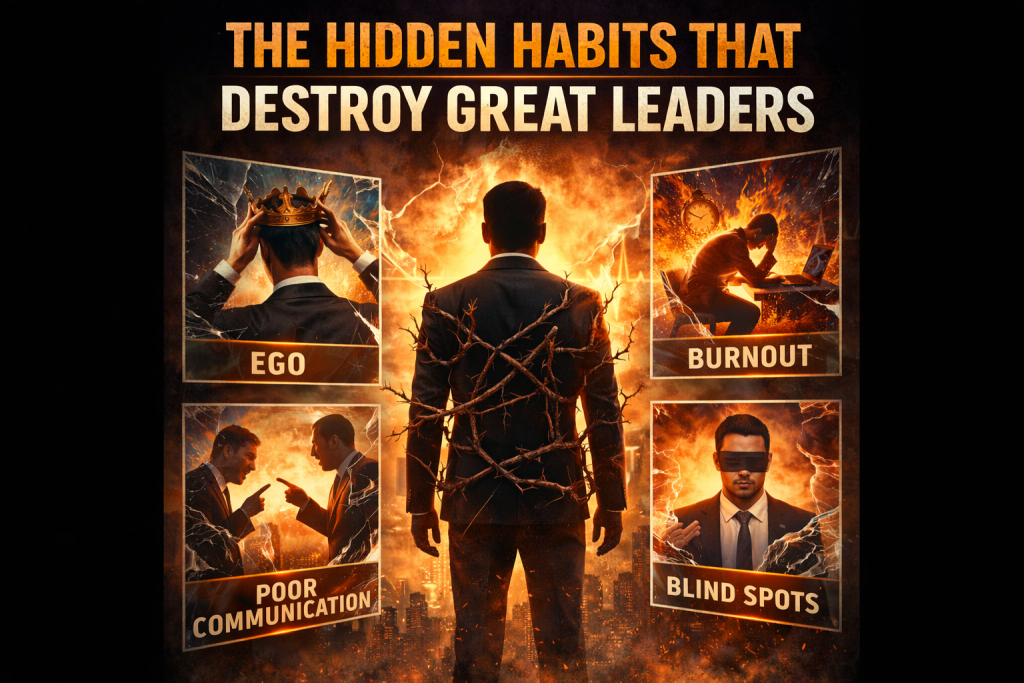
Leaders are often tamed by minor mistakes. Leadership is often admired from a distance.
People see the authority, the influence, the respect, and the success that comes with it. From the outside, great leaders appear confident, decisive, and in control.
But leadership is not only built through powerful decisions and bold vision.
It is also shaped by daily habits — the small patterns of thinking and behavior that repeat over time.
Sometimes, the very habits that once helped leaders rise to the top can quietly become the habits that begin to destroy their effectiveness.
Great leaders rarely fail because of one dramatic mistake.
More often, their decline begins with hidden habits that slowly erode trust, clarity, and influence.
The Habit of Believing You Must Have All the Answers
Many leaders reach their position because they are intelligent, capable, and decisive.
Over time, however, this strength can turn into a dangerous habit.
Some leaders begin to believe that they must always be the smartest person in the room.
Instead of listening deeply, they dominate conversations.
Instead of asking questions, they rush to provide answers.
The problem with this habit is that it quietly shuts down the intelligence of everyone else.
Great leadership is not about knowing everything.
It is about creating an environment where the best ideas can surface.
When leaders stop listening, they stop learning and the organization eventually stops growing.
The Habit of Avoiding Difficult Conversations
Many leadership failures are not caused by poor strategy.
They are caused by avoided conversations.
Some leaders hesitate to confront underperformance.
Others delay addressing toxic behavior.
Some avoid giving honest feedback because they want to remain liked.
But leadership is not about comfort.
When difficult conversations are avoided, small problems begin to grow quietly beneath the surface.
Performance declines.
Standards become unclear.
Trust weakens.
Great leaders understand that clarity is kindness, even when the conversation is uncomfortable.
The Habit of Overworking and Modeling Burnout
Many leaders believe they must constantly demonstrate relentless work ethic.
They arrive first.
They leave last.
They answer emails late at night.
At first glance, this looks like dedication.
But over time, something powerful happens: the leader’s behavior becomes the culture.
Teams begin to believe that exhaustion is the price of success.
Innovation declines because people are too tired to think creatively.
Morale declines because people feel constantly pressured.
And eventually, productivity begins to drop.
Great leaders understand something critical:
Sustainable performance always outperforms constant exhaustion.
The Habit of Needing Control
Control can feel safe for leaders.
When leaders control decisions, processes, and outcomes, they feel confident that things will go the right way.
But excessive control slowly suffocates organizations.
Employees stop taking initiative.
Creative thinking disappears.
People begin waiting for instructions instead of solving problems.
What began as leadership slowly becomes micromanagement.
The strongest leaders do not control everything.
They build capable people and trust them to perform.
The Habit of Protecting Ego Instead of Pursuing Growth
Leadership positions often bring recognition, respect, and status.
But with status comes a hidden risk: ego protection.
Some leaders begin avoiding feedback that challenges them.
Others surround themselves only with people who agree with them.
Over time, the leader becomes insulated from reality.
Growth stops.
The most powerful leaders remain deeply committed to personal development, no matter how successful they become.
They understand a simple truth:
The moment a leader stops growing is the moment their leadership begins to decline.
The Quiet Erosion of Leadership
The most dangerous leadership habits are rarely obvious.
They do not appear as dramatic scandals or visible failures.
Instead, they quietly erode the very foundations that leadership depends on:
Trust.
Clarity.
Energy.
Influence.
By the time the damage becomes visible, the habits that caused it have often been repeating for years.
The Mark of Truly Great Leaders
Great leadership is not defined by authority alone.
It is defined by self-awareness.
The leaders who remain effective over long periods are the ones who continuously examine their own habits, thinking patterns, and behaviors.
They ask themselves difficult questions:
Am I still listening?
Am I still learning?
Am I still leading in a way that strengthens others?
Because the greatest leaders understand something most people overlook.
Leadership is not destroyed by a lack of intelligence or capability.
It is destroyed by unexamined habits. That’s all for today. Remember, it works if you work it. Till we meet again in the next post. Peace.
 English